Trading With The Enemy
(How) should we do business with bad people?
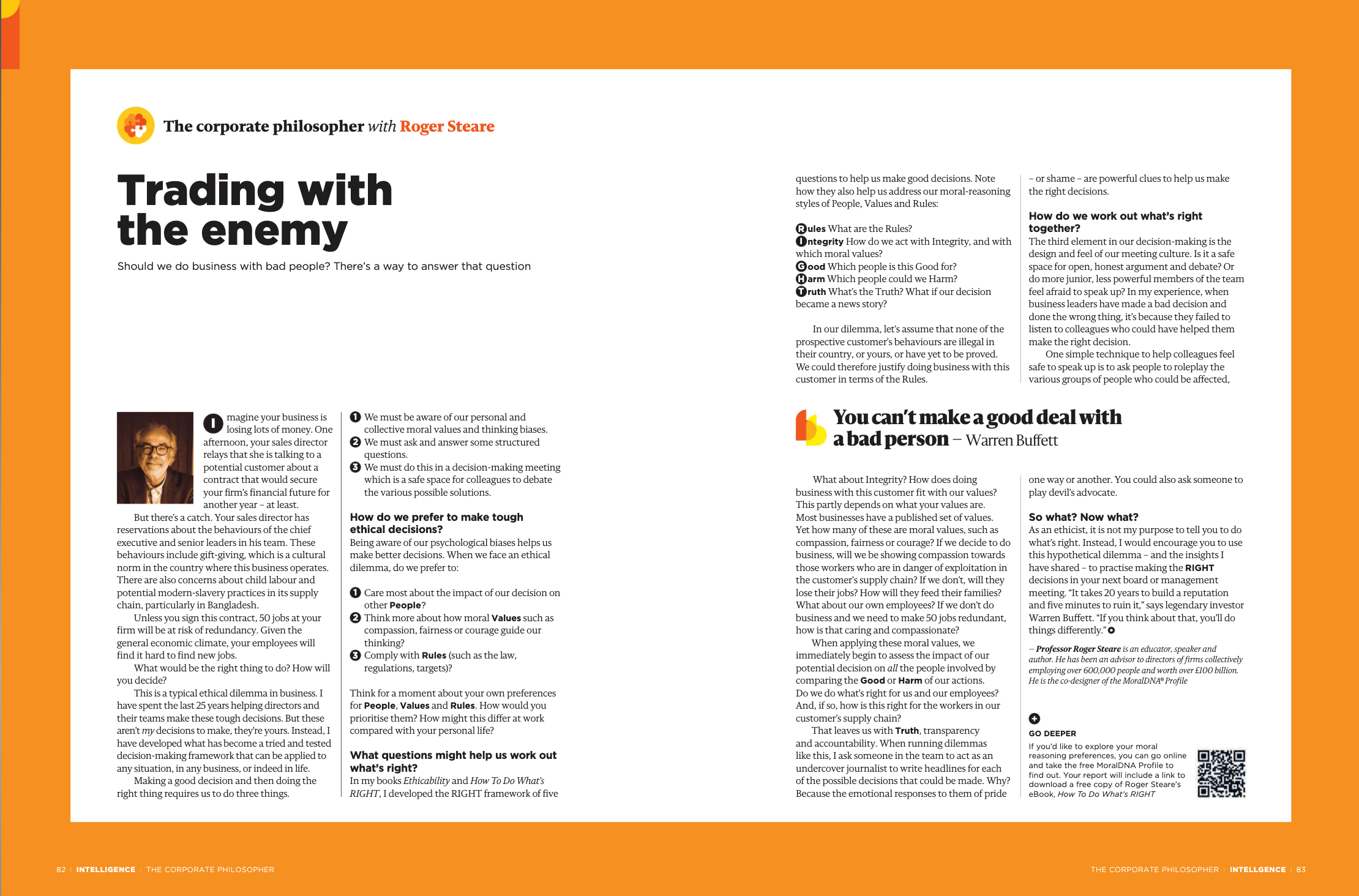
“You can’t make a good deal with a bad person.”
Warren Buffett
Imagine your business is losing a lot of money. One afternoon, your sales director tells you that they are talking with a potential customer about a contract that would secure your firm’s financial future for at least the next 12 months.
But there’s a catch. Your sales director has serious reservations about the behaviours of the CEO and other senior leaders in his team. These behaviours include “gift giving”, which is a cultural norm in the country where this business operates. There are also concerns about child labour and potential modern slavery practices in its supply chain, particularly in Bangladesh.
Unless you sign this contract, 50 jobs at your firm will be at risk of redundancy. Given the general economic climate, your employees will find it hard to find new jobs.
What would be the right thing to do? How will you decide?
This is a typical ethical dilemma in business, and I have spent the last 25 years helping directors and their teams make these tough decisions. But these aren’t my decisions to make, they’re yours. Instead, I have developed what has become a tried and tested decision-making framework that can applied to any situation, in any business, or indeed in life.
Making a good decision and then doing the right thing requires us to do three things.
- We need to be fully aware of our personal and collective moral values and thinking biases.
- We need to ask and answer some structured questions.
- We need to do this in a decision-making meeting which is a safe space for colleagues to debate the various possible solutions.
How do we prefer to make tough, ethical decisions?
Being aware of the biases in the way we think helps us to better decisions. When we face an ethical dilemma do we prefer to:
- Care most about the impact of our decision on other People.
- Think more about how moral Values such as compassion, fairness, or courage guide our thinking.
- Comply with Rules, the law, regulations, targets etc.
Think for a moment about your own preferences for People, Values and Rules. How would you prioritize or order them? How might this differ at work compared with your personal life?
If you’d like to explore your moral reasoning preferences, you can go online and take the FREE MoralDNA Profile to find out!
What questions might help us work out what’s right?
In my books ethicability and How To Do What’s RIGHT, I developed the RIGHT framework of five questions to help us make good decisions. You can also see how they help us to address our moral reasoning styles of People, Values and Rules:
Rules – What are the Rules?
Integrity – How do we act with Integrity, and with which moral values?
Good – Which people is this Good for?
Harm – Which people could we Harm?
Truth – What’s the Truth? What if our decision became a news story?
In this dilemma, let’s assume that none of the prospective customer’s behaviours are illegal in their country, or yours, or have yet to be proved. We could therefore justify doing business with this customer in terms of the Rules.
What about Integrity? How does doing business with this customer fit with our values? In part this depends on what your values are. Most businesses have a published set of values, but which of these organisational values are moral values such as compassion, fairness or courage? If we decide to do business, will we be showing compassion towards those workers who are in danger of exploitation in the customer’s supply chain? If we don’t, will they lose their jobs? How will they feed their families? What about our own employees? If we don’t do business and we need to make 50 jobs redundant, how is that caring and compassionate?
When applying these moral values, we immediately begin to assess the impact of our potential decision on all the people involved by comparing the Good or Harm of our actions. Do we do what’s right for us and our employees? And if so, how is this right for the workers in our customer’s supply chain?
That leaves us with Truth, transparency and accountability. When running dilemmas like this, I will ask someone in the team to act as an undercover journalist to write headlines for each of the possible decisions that could be made. Why? Because the emotions of pride – or shame – are powerful clues to help us make the right decisions.
How do we work out what’s right together?
The third element in our decision-making is the design and feel of our meeting culture. Is it a safe space for open, honest argument and debate, or do more junior, less powerful members of the team feel afraid to speak up? In my experience, when business leaders have made a bad decision and done the wrong thing, it’s because they failed to listen to colleagues who could have helped them make the right decision.
One simple technique to help colleagues feel safe to speak up is to ask people to role play the various groups of people who could be affected, one way or another. You could also someone to play the Devil’s Advocate.
So what? Now what?
As an ethicist, it is not my purpose in life to tell other people to do what’s right. Therefore, I’m not going to tell you what I would do in this situation. Instead, I would encourage you to use this hypothetical dilemma, and the insights I have shared, to practice making the RIGHT decisions in your next Board or management meeting.
I will however leave you with another insight from one of our most successful business leaders: